Kevin Buist, December 8, 2023
Kim Asendorf’s work navigates the paradox of the permanent art object and the dynamic digital medium
This essay was originally published on Outland.art.
“The code is the artwork,” Kim Asendorf said during a recent conversation. He quickly followed this axiom with a caveat: “but the visual is more important.” It’s a contradiction to identify both the invisible armature and its visual expression as the most important part of a work. But the best art embodies contradictions, and there are plenty of them in Asendorf’s work. These paradoxes are shared by other artists whose careers, like Asendorf’s, have followed the trajectory from net art to NFTs. Making art on the internet requires artists to navigate several overlapping polarities. There’s a desire for permanence, to situate artworks within the deep cultural history that precedes them. But this is tempered by the ephemerality of link rot, browser updates, and other types of rapid obsolescence that digital media entails. There is also a polarity between objects and experiences. Historically, visual artworks have been understood as objects. While digital artworks are objects of a sort, they can also be thought of as sets of instructions to create ephemeral experiences. So what is an internet artist to do: insist on the objecthood of digital things, or discard objecthood and move toward pure experience? Asendorf’s work deftly navigates these questions, even if it can’t ultimately settle on clear resolutions. Resolutions can be dead ends anyway, and Asendorf’s oeuvre–both permanent and ephemeral, manifesting as objects and experiences–is better for its refusal to settle on easy answers.
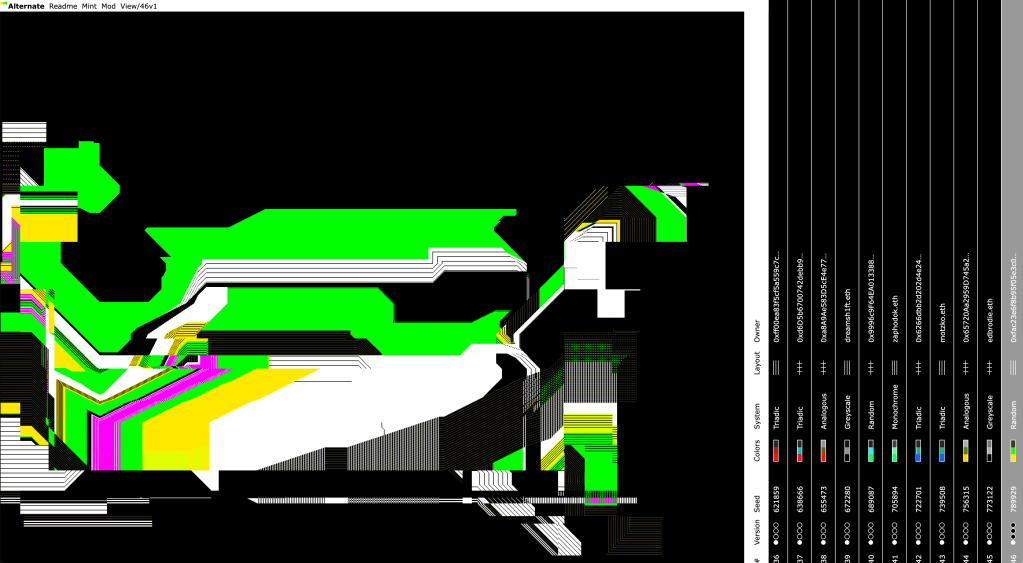
Asendorf’s newest work, Alternate, is a collection of fully on-chain generative art NFTs made using the artist’s custom pixel-sorting algorithm, unique smart contract, and bespoke project website. Each piece begins with pixelated patterns with a limited color palette, which instantly begin to animate and distort, pushed and pulled as they pulse and radiate around the screen. The elements of the abstract compositions are not moving as units, instead unseen forms are grabbing and smudging areas of pixels, creating an endless series of temporary compositional elements that become part of the background as new ones are formed. The overall look of each piece remains consistent, though the animated patterns never loop. Alternate is far from the only series of abstract generative NFTs, but Asendorf crafted this work in a way that dives headlong into the productive tensions of contemporary digital art.
Asendorf has made similar series of abstract generative NFTs before, namely Monogrid (2021) and Cargo (2023). Alternate is clearly an evolution of these works, but it’s distinct in several ways. The new series features what Asendorf calls a “secondary market hack.” Each piece contains four potential states with differing compositions and animation elements. These states can be accessed by running a special mod function built into the contract that reveals a new version of the piece. The function can only be run three times for each work, it’s irreversible, and the cost to run it increases each time. This strategy allows collectors to change their piece after they mint it, and it provides a way for the artist to earn money after the initial sale, despite the fact that commissions on secondary sales have become optional on most NFT marketplaces.
Alternate is Asendorf’s first fully on-chain NFT series. Referring to NFTs as “on-chain” has become something of a marketing buzzword. In the simplest sense, it means that the smart contract of the NFT contains all the code necessary to generate the image that constitutes the work. This is notable because most NFTs simply reference a file with a hyperlink, which means that even if the blockchain record of the NFT survives, the work’s fate is threatened by link rot or other possible failures. Despite the vogue for on-chain art, Asendorf says, many of these projects, even the most popular ones, fake their on-chain credentials. Some complex projects are technically on-chain, but still make use of a secondary server to render properly on marketplace websites where they are viewed. Alternate, on the other hand, uses only 9 kilobytes of code, meaning that no outside resources or servers are needed to make the work display properly on nearly any browser.
The push for on-chain work is a reflection of the desire for permanence in digital art. In the scope of art history, the phenomenon of art on the internet is still a young one. Despite its newness, countless early net art projects are lost forever, victims of server shut-downs and obsolete formats. Art on the internet is akin to photocopied zines produced with paper that’s doomed to yellow, or even the paintings Henri de Toulouse-Lautrec executed on non-archival cardboard, confined to extremely dim galleries to forestall their decay. The move toward on-chain art is a protest against planned obsolescence. It’s an attempt to elevate digital art to its rightful place alongside painting and sculpture, where objects outlive their creators by decades or even centuries. This is a noble goal, but even purely on-chain work like Asendorf’s has one huge dependency: he’s betting that the Ethereum blockchain itself will survive.
Insisting on the permanence and self-sufficiency of digital objects also means contenting with screens on which they’re displayed. For Asendorf, and all digital artists making work to be displayed on the infinite unknown screens of collectors and institutions, the screen–in the most literal sense–is ultimately the most crucial object. Asendorf weds the digital object of the on-chain NFT with the physical object of the variable screen by making the animations of Alternate sensitive to the size of screen on which they’re displayed, creating different patterns at every possible dimension. Asendorf’s patterns radiate off of the edges of the object on which they’re displayed, whatever size and shape that object may be.
Alternate is a project that looks backward and forward. It’s representative of the contradictions that define digital art of the current moment. It makes productive use of the NFT as a distribution mechanism, despite a cooling overall market. It aims for permanence by living on-chain with no other dependencies, despite the inherent impermanence of work made for screens. It explores the objecthood of digital things by focusing on the primacy of the code, while also contending with the physicality of the screen. Even the code itself is not written to manipulate digital objects within the image, but rather to manipulate pixels, the atomic unit of the digital image. Asendorf describes his practice as a kind of searching, a quest to write code that will generate images that surprise even him.
 kevinbuist.com